
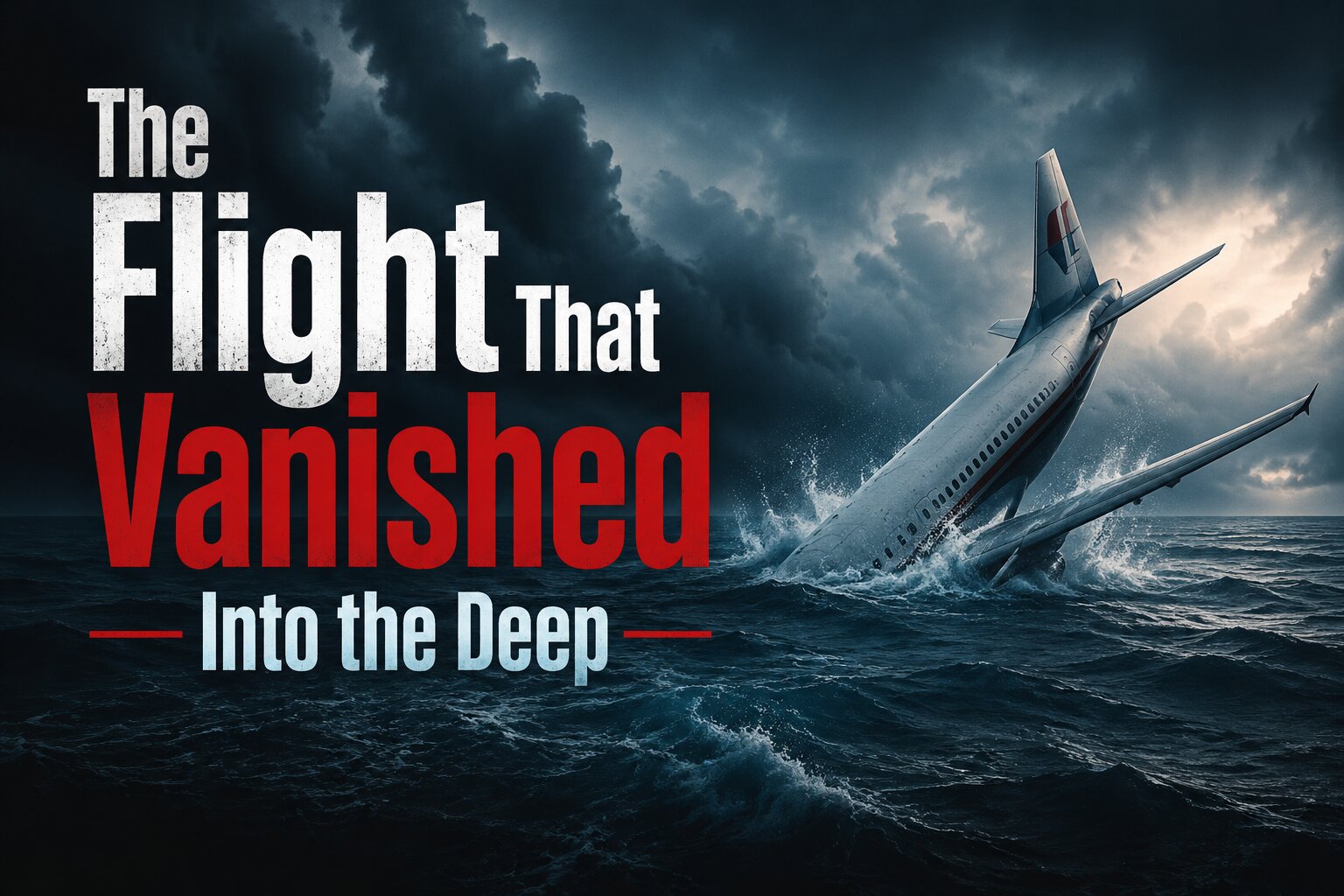
The world has always been captivated by mysteries of the skies and the oceans. We look up and see planes cutting through clouds, reliable and predictable, and we look down into the sea, vast and unknowable, teeming with secrets. But some mysteries are born at the intersection of these two realms. One such mystery occurred on a seemingly ordinary day, when Flight 712 disappeared into the sea, leaving nothing behind—no wreckage, no distress signal, not even a clue.
It was a Thursday morning when Flight 712, a mid-sized commercial airliner, departed from Port Haven International Airport. The weather was fair, the sun cast a golden hue over the tarmac, and passengers settled into their seats, chatting about their plans or dozing off as the engines hummed to life. The captain, a seasoned pilot named Daniel Graves, was known for his calm demeanor and precise flying skills. He had flown this route dozens of times, navigating the coastal airspace with a practiced eye.
The flight took off at 10:15 AM, bound for Elmsworth City, a bustling metropolis across the Sapphire Sea. At first, nothing seemed unusual. The plane climbed smoothly, and the flight attendants went about their routine, serving coffee and light snacks. Passengers glanced at their screens, listened to music, or gazed out the windows at the sparkling waters below.
But approximately thirty minutes into the flight, over a stretch of sea notorious for unpredictable currents, the plane began to behave oddly. Instruments flickered. The artificial horizon wavered. Captain Graves adjusted the controls, attributing the minor fluctuations to the patchy air currents that were common in this region. “Nothing to worry about,” he announced over the intercom, his voice calm but firm.
Then came the first anomaly. The transponder, which allows air traffic control to track aircraft, began sending irregular signals. Controllers noticed the inconsistencies almost immediately. “Flight 712, we’re seeing erratic readings,” one controller said. “Confirm your altitude and heading.”
“Reading normal,” Graves replied, though he noticed that his instruments seemed slightly delayed. The horizon outside looked… off. The sea below, normally a deep blue, shimmered strangely, almost like glass. He dismissed the thought. Pilots are trained to expect optical illusions; the sun can play tricks on the eye at certain angles over water.
Minutes later, the plane encountered a sudden turbulence. Not a storm, not the kind one can predict, but a strange, undulating movement that made the aircraft feel as though it were floating on waves instead of flying above them. Passengers murmured nervously. Drinks spilled. Some clutched their armrests, expecting the usual rattling, but this was different. It felt as though the plane itself were being cradled by something massive and unseen.
Captain Graves attempted to radio the control tower again, but static filled the cockpit. The radio crackled in a manner that suggested interference, but no storm was reported in the region. Instruments started to fail intermittently. Altitude readings fluctuated wildly, as if the plane were both rising and sinking at the same time.
Then, without warning, the plane appeared to… vanish.
From the perspective of air traffic control, Flight 712 simply ceased to exist. The radar blip disappeared. Flight 712 had crossed a stretch of ocean known for its deep underwater trenches, but even the deepest parts of the sea had never swallowed an aircraft without a trace.
Search and rescue teams were dispatched immediately. Helicopters, boats, and sonar-equipped submarines combed the waters. The authorities expected to find wreckage, debris, a life raft, perhaps even survivors clinging to floating seats or luggage. Days passed. Nothing was found. Not a single item. It was as though the ocean itself had swallowed Flight 712 whole.
Speculation ran rampant. Was it a meteorological anomaly? A freak underwater vortex that somehow dragged the plane down? Could it be that some rare, natural phenomenon had created a temporary rift between air and sea, allowing the plane to sink into a hidden trench or underwater cavern?
The more scientists investigated, the stranger the case became. Sonar scans of the ocean floor revealed vast, cavernous structures previously undocumented. Theories began to circulate about a submerged, lost city—an Atlantis-like expanse that could theoretically conceal an entire aircraft. But even these cavern systems were thoroughly mapped, and nothing resembling Flight 712 was ever discovered.
Amid the chaos, stories began to emerge from individuals who claimed to have seen the plane after its disappearance. Fishermen in distant parts of the Sapphire Sea reported glimpses of an aircraft gliding beneath the waves, visible for just a moment through the crystalline water, moving as though it were flying underwater. Some even described seeing lights from the cabin flickering through the depths. These accounts were dismissed by authorities as hallucinations or misidentifications, but the sheer number of reports made them hard to ignore entirely.
Meanwhile, families of passengers waited in agony, clinging to the hope that somehow Flight 712 would be found. Each day without news was a day of mounting despair. Yet in some corners of the world, interest in the story grew into obsession. Marine researchers, conspiracy theorists, and even technology enthusiasts poured over satellite imagery, flight data, and oceanographic maps, searching for a clue that might explain the impossible.
One night, nearly two months after the disappearance, a retired pilot named Samuel Keating claimed he had experienced something similar decades ago. Keating had been flying a cargo plane over the Sapphire Sea when a sudden, inexplicable “bubble” of calm surrounded his aircraft. Instruments malfunctioned. The horizon appeared fluid. The plane seemed to descend into the water—but when he emerged, everything was normal, as if nothing had happened. His account was largely ignored, but it added a chilling resonance to the Flight 712 case.
Theories continued to proliferate. Some believed that the plane had been swallowed by an enormous, previously unknown underwater sinkhole. Others suggested it had been caught in a natural electromagnetic anomaly that temporarily created a “pocket dimension” beneath the ocean. A few even proposed something more sinister: that Flight 712 had been targeted by secret military technology, abducted into a hidden facility far beneath the waves.
Despite the theories, no evidence ever surfaced. The ocean had seemingly erased every trace of Flight 712. Investigations were officially closed after a year, with authorities labeling the case “unresolved” but “improbable to solve given current technology.” For the world, Flight 712 became a ghost story, a cautionary tale about the perils of flying over the deep sea.
Yet the mystery did not end. Every now and then, new reports surfaced: a diver glimpsed a metallic glint deep below; a remote underwater drone captured a fleeting image of a shape reminiscent of a fuselage; even sonar scans occasionally registered an anomaly resembling a wing or tail. Each lead ultimately went cold, reinforcing the sense that Flight 712 had vanished into a hidden realm beneath the waves—a place untouched by human hands.
In the years that followed, Flight 712 became legend. Authors wrote books, filmmakers attempted documentaries, and enthusiasts mapped the Sapphire Sea in painstaking detail, searching for signs of the lost plane. But no matter the effort, Flight 712 remained elusive, an enduring mystery that defied reason.
Some theorists took the disappearance even further, proposing that the plane had somehow adapted to life underwater. Perhaps it had settled into one of the vast, cavernous trenches, safe from detection but suspended in a state of suspended animation, preserved in the cold embrace of the deep. The idea was fantastical, bordering on science fiction, yet it captured the imagination: an entire airplane, flying through the sea, hidden from the world, carrying passengers into a watery limbo.
For Captain Graves, who retired shortly after the disappearance, the experience haunted him until his final days. He often spoke of the shimmering water and the eerie sensation of flying as if on a liquid highway, guided by an invisible force. Though he never fully explained what happened, he maintained one fact above all else: Flight 712 was not destroyed. It had vanished—but not forever. It existed in a realm between air and water, hidden from human eyes, waiting for the day when it might resurface.
And so the legend of Flight 712 endures. It reminds us of the limits of our understanding, the vastness of the ocean, and the uncharted mysteries that still linger above and below. Perhaps one day, modern technology or a stroke of luck will reveal what became of the plane, but until then, Flight 712 remains a ghost in the sky and a phantom in the sea—a story that continues to baffle, intrigue, and terrify anyone who dares to imagine the unimaginable.
Somewhere, deep beneath the waves, a silver fuselage glints in the sunlight filtering through the water. Its passengers are suspended in a dreamlike state, as if sleeping while flying underwater. And above them, the world continues, unaware that Flight 712 has found a new path—hidden, eternal, and unreachable.