
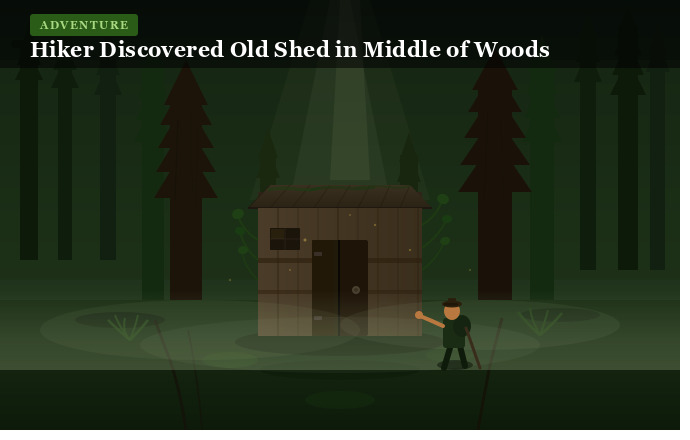
Deep in a forest where no trail leads, a solitary hiker stumbled upon something that should not have been there — and the mystery only deepens the further you look.
There are places in the world that feel genuinely forgotten. Not abandoned in the modern sense — where a derelict strip mall or an empty office block carries the ghost of recent commerce — but truly, deeply forgotten. Places where the earth has been slowly, patiently reclaiming what was once taken from it. Where roots push through floorboards, where moss spreads like green velvet across wooden beams, and where silence has weight.
It was in exactly such a place that 31-year-old hiker and amateur trail photographer Daniel Mercer made a discovery that has since captivated thousands of people across the internet, drawn the attention of local historians, and inspired a kind of quiet wonder that is increasingly rare in a world where every inch of land seems mapped, catalogued, and explained.
He found a shed.
Not at the edge of a trail, not marked on any map, not visible from any road or clearing. A shed, standing alone and upright in the dense heart of a forest in the rural Appalachian foothills, surrounded by trees so old and close together that sunlight barely reached the ground around it. A shed with its door slightly open, ivy climbing its rotting walls, and no human footprint within miles.
The Walk That Changed Everything
Daniel had been hiking for about four hours when he found it. He had set out that morning from a remote trailhead, following an unmarked path he had spotted on an old topographic map purchased from a secondhand bookstore months earlier. He was not looking for anything in particular. He rarely was. For Daniel, hiking was primarily an act of looking — at light, at texture, at the way a forest changes character depending on elevation and moisture and the particular slant of a cloudy October afternoon.
“I had been pushing through dense undergrowth for maybe forty minutes off the main trail,” he later wrote in a post that has since been shared hundreds of thousands of times. “There was no path. I was literally moving between trees, pushing branches out of my face. And then I stepped into this small clearing — not really a clearing, more like a gap in the canopy — and there it was.”
The shed was small. Perhaps twelve feet long and eight feet wide. It was built from rough-cut timber, the kind of boards that were clearly milled by hand rather than machine, with uneven widths and grain patterns that suggested very old wood. The roof was a simple pitched design, covered in what had once been wooden shingles but was now largely a green carpet of moss and lichen. The walls leaned slightly inward on the left side, suggesting the ground beneath had shifted over time, but remarkably, the structure had not collapsed.
Most remarkable of all was the door. It was ajar. Not dramatically — perhaps three or four inches — but enough to suggest that either someone had been there recently and failed to close it, or, more likely, the frame had warped so severely over the years that the door could no longer fully latch. From within, if you stood at the right angle, Daniel later said, you could see almost nothing. Just darkness, and the faintest suggestion of shapes inside.
What Was Inside
Daniel did not rush. He circled the shed twice, documenting it from every angle with his camera, before approaching. He examined the exterior closely. The wood was very old — grey with age and wet with decades of moisture. Nails, where visible, were hand-forged iron rather than modern steel wire nails, which pointed to construction in the nineteenth century or possibly earlier. There was no signage. No lock. No markings of any kind, save for what appeared to be a set of crude initials carved into one of the doorframe posts: “E.W.” followed by what might have been a date, though the carving was too worn to read clearly.
When he finally pushed the door open — gently, careful not to disturb anything — what he found inside was a remarkable freeze-frame of an older world.
The interior was dim and smelled of earth and old wood and something faintly sweet that he could not identify. Along the back wall stood a crude wooden workbench, its surface covered in a thick layer of dust and leaf debris that had blown in through the years. Hanging above the bench on rusted iron hooks were several tools: a hand saw, a wooden-handled hammer, what appeared to be a drawknife, and a collection of chisels and awls so corroded they were almost unrecognizable. A small iron stove sat in the corner, its chimney pipe long since collapsed, its door hanging open on a single remaining hinge.
On a shelf above the workbench were three glass jars, still sealed. Their contents were impossible to identify through the dark, age-fogged glass. Beside them sat a folded piece of cloth — possibly canvas — and beneath the bench, half-buried in dirt and leaves, was what appeared to be a leather-bound book of some kind. Daniel photographed everything but touched nothing. “It felt like a crime scene,” he said. “Like disturbing it would be wrong somehow.”
The Internet Reacts
When Daniel posted his photographs — 47 of them, spanning exterior, interior, details of tools, and the remarkable carved initials — the response was unlike anything he had experienced before. Within 24 hours, the post had been shared across multiple platforms and had attracted tens of thousands of comments from people offering theories, historical context, personal memories, and emotional reactions that ranged from wonder to something approaching grief.
Historians and historical hobbyists were particularly active in the comments. Several pointed out that the style of construction — the hand-forged nails, the rough-cut timber, the simple joinery — was consistent with structures built in the mid-to-late 1800s in rural Appalachian communities. During that period, small outbuildings known as “work sheds” or “tool houses” were extremely common on homesteads and farmsteads. They were used to store equipment, process timber, cure leather, and carry out any number of tasks that required a dedicated workspace separate from the main dwelling.
This raised an immediate question: where was the main dwelling? If the shed was part of a homestead, there should be other structures — or at least the remains of other structures — somewhere nearby. A cabin foundation. A well. Cleared land that had since regrown. Daniel returned the following weekend specifically to search for these things.
He found them. About 200 meters north of the shed, beneath a thick layer of leaf litter and encroaching forest, were the unmistakable stone footings of a cabin. Two rooms, by the look of the foundations. A collapsed stone chimney nearby. The ghost of what might have been a garden plot, detectable only by a slight change in soil color and the presence of certain plant species that tend to follow human settlement. Someone had lived here, once. A family, perhaps. And then they had left — or something had taken them — and the forest had moved in.
A Forgotten History
The region where Daniel made his discovery has, like much of rural Appalachia, a layered and often melancholy history. In the nineteenth century, these mountains were home to thousands of small farming communities — tight-knit, largely self-sufficient families who cleared land, built homes from local timber, and lived lives that left very few written records. Many of these communities were gradually depopulated through the twentieth century as economic opportunities concentrated in cities, as young people left and did not return, and as successive generations found less reason to maintain ancestral land.
Some of these homesteads were simply abandoned. The people walked away, or died, and their children had no interest in returning to work land that could not feed a modern family. Nature, patient and indifferent, moved back in. Trees grew through floors. Roofs collapsed under the weight of snow and time. Stone foundations crumbled. Within a generation or two, all visible evidence of a human life could vanish entirely beneath a thick, indifferent forest.
What makes Daniel’s shed remarkable is not its existence — there are surely thousands of such structures still standing in remote corners of American forests, each one a small monument to a forgotten life — but its improbable state of preservation. Most structures of that age and construction, left unattended in a humid forested environment for over a century, would not be standing. The combination of moisture, insects, fungal decay, and simple gravity would have reduced them to a low mound of rotting wood indistinguishable from a fallen tree.
This one was still upright. Still functional, in a structural sense, if barely. Something about its particular placement — perhaps the density of the surrounding trees provided windbreak, perhaps the slight rise in the ground gave it better drainage — had conspired to preserve it past any reasonable expectation.
The Initials and the Mystery of E.W.
The carved initials “E.W.” have become a focal point of online speculation. A local genealogical society, upon hearing of the discovery, began researching land records and census data for the area. Their preliminary findings, shared publicly, suggest that a family named Whitmore owned land in the relevant township in the 1870s and 1880s. The family patriarch, an Elias Whitmore, is listed in an 1880 census as a farmer and carpenter — precisely the kind of man who might have built a working shed and carved his initials into its doorframe.
What happened to the Whitmore family is, at present, unclear. They disappear from local records after the 1890 census. There is no death record, no sale of land, no forwarding address. They were there, and then they were not. Whether they moved west, as many Appalachian families did in that era, or whether something more dramatic ended their residence on that land, is unknown.
The three sealed glass jars in the shed remain unexamined. Daniel, to his credit, has been in contact with a local historical preservation society and is working with them to have the shed and its contents properly documented by professionals before anything is moved or opened. He is clear that he does not want to disturb what might be, in its own quiet way, an important piece of local history.
“I don’t want to be the person who breaks those jars and finds out they’re full of old nails,” he said in a follow-up interview. “But I also don’t want to be the person who misses something that mattered to someone, once.”
What This Discovery Means
On the surface, Daniel Mercer’s discovery is a small, local thing. A shed in the woods. A curiosity. But the response it has generated speaks to something larger — a collective hunger, perhaps, for evidence that the world still contains surprises. That there are still places not yet fully mapped, explained, or reduced to a data point. That a person can walk off a trail on an October morning and find themselves face to face with a life that was lived, and loved, and then left behind in the trees.
The shed of Elias Whitmore — if that is indeed who built it — will not change history. It will not rewrite the textbooks or upend what we know about nineteenth-century Appalachia. But it will, perhaps, remind us that history is not only what is written down. It is also what is carved into a doorframe with a penknife, preserved by accident in a corner of a forest that nobody thought to visit for a very long time.
Daniel plans to return in the spring, this time with a historian and a structural engineer, to properly assess what remains of the homestead. He hopes the shed can be preserved in some form — not restored, necessarily, but documented and protected from further deterioration.
Until then, it stands where it always has, in the middle of the woods, door slightly ajar, waiting. As it has waited, apparently, for well over a hundred years.
Some things, it turns out, are very good at waiting.