
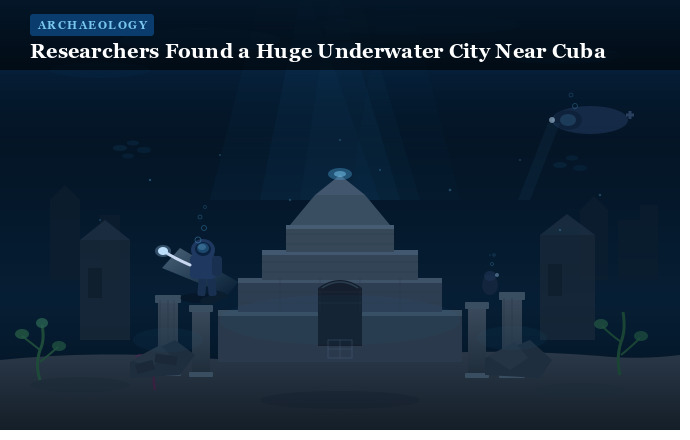
Beneath the warm, turquoise waters of the Caribbean Sea, a team of marine scientists and archaeologists may have just uncovered the greatest lost civilization ever found — and it has been hiding in plain sight for thousands of years.
The Caribbean has always been a sea of stories. Pirates and conquistadors, hurricanes and shipwrecks, centuries of trade and conflict beneath skies so blue they seem almost artificial. But nothing in the recorded history of this region — nothing in any history book, any myth, any legend passed down through generations of island people — could have prepared the world for what a team of Canadian researchers, working in collaboration with Cuban scientists, first reported finding in the deep waters off the western coast of Cuba.
A city. An enormous, ancient, submerged city.
Stretching across an estimated area of nearly two square kilometers on the ocean floor, the site consists of what appears to be a complex arrangement of stone structures: pyramids, roadways, columns, platforms, and carved geometric formations resting in near-perfect symmetry at depths ranging from 600 to 750 meters below the surface. The structures are made from granite and other hardened stone materials, many of them perfectly cut and fitted together with a precision that rivals anything built in the ancient world above ground.
The implications, if confirmed, are staggering.
How the Discovery Was Made
The story begins not with a dramatic dive or a chance observation, but with data. In the early stages of a deep-water survey being conducted for commercial purposes — specifically, to map the ocean floor for potential undersea pipeline routing — sonar equipment aboard a research vessel began returning unusual readings in a remote section of the Yucatán Channel, the body of water that separates Cuba’s western tip from Mexico’s Yucatán Peninsula.
The sonar imagery showed regular geometric patterns on the seafloor. In deep-ocean surveys, geometric regularity is immediately suspicious. Natural underwater geology — volcanic formations, coral reef structures, sedimentary deposits — almost never produces the kind of right angles, symmetrical arrangements, and repeated modular shapes that the sonar was detecting. The team, led by ocean engineer Paulina Zelitsky and her husband Paul Weinzweig, diverted their attention from the commercial survey and began a dedicated investigation of the anomaly.
What followed were months of painstaking work: multiple sonar passes, video footage captured by remotely operated underwater vehicles, analysis of rock samples dredged from the site, and consultations with geologists, archaeologists, and historians. The footage retrieved by the ROVs was the moment everything became undeniable. There, on screen, were structures that could only be described as buildings. Pyramidal forms. Wide, flat platforms connected by what appeared to be stone-paved pathways. Upright columns arranged in rows. Massive carved blocks etched with geometric symbols.
“What we found is simply overwhelming,” Zelitsky stated in early communications about the discovery. The structures appeared, in multiple respects, to parallel the architectural traditions of ancient Mesoamerican civilizations — the Maya, the Olmec — but in a location and at a depth that placed them far outside the known range of any recognized culture.
What the Structures Reveal
The architectural complexity of the site is what has most electrified the scientific community. This is not a scattering of fallen stones or a vague collection of underwater rocks that requires imaginative interpretation. The site contains multiple distinct structure types arranged in a manner that unmistakably suggests deliberate, sophisticated urban planning.
The largest identified structure is a stepped pyramid approximately 40 meters in height, comparable in scale to several well-known pyramids found in Mexico and Central America. Its sides are composed of enormous granite blocks, each cut with flat faces and sharp corners. The blocks are fitted together without mortar, relying instead on precise shaping — a technique well documented in ancient Inca and Egyptian construction but not previously associated with any known culture in the Caribbean basin.
Surrounding the central pyramid are what appear to be secondary buildings, smaller and more varied in shape, arranged along a grid of stone-paved avenues. Some structures have clearly identifiable doorway openings. Others are more ambiguous — platform-like surfaces that may have supported wooden or organic superstructures long since dissolved by centuries of saltwater immersion. Along several of the wider avenues, evenly spaced columns remain upright, their surfaces encrusted with centuries of marine growth but their basic forms intact.
Most intriguing of all are the carved symbols observed on multiple surfaces across the site. Researchers have documented recurring geometric motifs — spirals, concentric circles, angular interlocking patterns — that bear striking resemblance to symbolic vocabularies found in ancient Mesoamerican art. Whether these are decorative, functional, or carry some form of written or numerical meaning has not yet been determined. The sheer density of the site, and the depth at which it sits, makes direct examination difficult and time-consuming.
The Age Question: How Old Is This City?
This is where the discovery enters genuinely extraordinary territory, and where the scientific community has proceeded with the greatest caution.
For a stone structure to be sitting at 600 to 750 meters below the current surface of the Caribbean Sea, the land on which it was originally built must have been above sea level at some point in the distant past. Given the current rate of sea level rise and the estimated geological history of the region, preliminary calculations suggest that the land at this depth would have last been above water somewhere between 6,000 and 12,000 years ago — placing the potential construction of this city firmly in the Mesolithic or early Neolithic period.
To put that in context: the Egyptian pyramids at Giza were built approximately 4,500 years ago. The oldest confirmed urban settlements in Mesopotamia — long considered the cradle of civilization — date to roughly 6,000 years ago. If the Cuban underwater city dates to 10,000 or 12,000 years before the present, it would predate every currently recognized civilization on Earth by thousands of years.
This is a claim so dramatic that the scientific community has, quite rightly, treated it with intense scrutiny. Several geologists have pointed out that the tectonic history of the Caribbean is exceptionally complex, involving multiple subduction zones, volcanic activity, and the possibility of local land subsidence that could cause sections of coastline to sink far more rapidly than global sea level change alone would predict. It is possible, some argue, that the land on which this city was built sank due to a localized geological event — an earthquake, a volcanic collapse — rather than the gradual global process of post-Ice Age sea level rise. This would potentially allow for a more recent date of construction.
Without reliable methods of directly dating the stone itself — and granite, unlike organic material, cannot be carbon-dated — establishing a firm age for the city remains one of the most pressing and most difficult challenges facing researchers.
The Lost Civilization Problem
If the Cuban underwater city is real and ancient — and the physical evidence strongly suggests it is real, whatever its age — it raises a question that goes far beyond the specifics of Cuba or the Caribbean: who built it?
No known ancient civilization is associated with the western Caribbean at any period. The Maya, the most sophisticated pre-Columbian culture in the region, did not develop pyramid-building traditions until roughly 3,000 years ago, and their territory centered on the Yucatán Peninsula and Guatemala, not the open sea. The Olmec, often considered the mother culture of Mesoamerica, emerged around 1,500 BCE. Neither culture matches the timescale implied by the site’s depth.
This leaves researchers with a deeply uncomfortable but scientifically fascinating possibility: that there was a civilization in the ancient Caribbean — organized, architecturally sophisticated, and capable of constructing monumental stone structures — that has left no other trace in the archaeological record. No above-ground ruins. No artifacts in recognized museums. No mention in any indigenous oral tradition that has survived to the present. A civilization that existed, flourished, built cities, and then vanished so completely that not even its memory remained.
The idea is not, in principle, impossible. Human history is full of populations that disappeared without leaving detectable records — particularly populations that lived in coastal and low-lying areas that were subsequently submerged by rising seas as the last Ice Age ended and global temperatures climbed. In fact, archaeologists have long theorized that the transition period between roughly 10,000 and 6,000 BCE was a time of massive, rapid sea level change that would have displaced and likely destroyed numerous coastal communities worldwide. The Cuban site may be one of the most dramatic physical confirmations of that theory yet discovered.
The Controversy and Skepticism
Not everyone is convinced, and that is exactly as it should be in serious scientific inquiry.
Several prominent marine archaeologists have urged caution, noting that deep-water geological formations can, under certain conditions, produce structures that appear engineered but are in fact entirely natural. A phenomenon known as “rectangular jointing” can cause volcanic basalt to fracture in remarkably regular geometric patterns. Underwater landslides can deposit large stone formations in arrangements that superficially resemble constructed platforms. The tendency of the human brain to detect patterns — to see right angles and symmetry where none was intended — is well documented and must be accounted for in any analysis of ambiguous underwater imagery.
These objections are legitimate, and researchers have acknowledged them directly. What distinguishes the Cuban site from known examples of natural geometric formations, they argue, is the scale and complexity of the arrangement: not one or two regular formations, but dozens of distinct structures spread across a wide area in a coherent spatial relationship to one another. Natural processes can produce local geometric regularity. They do not, as a general rule, produce what appears to be a planned city grid.
The debate will ultimately be resolved — or at least significantly advanced — by direct physical examination. Plans are underway, pending funding and logistical arrangements, for a manned deep-sea expedition to the site using submersible craft capable of reaching the required depths. Only hands-on investigation, the collection of properly catalogued samples, and detailed three-dimensional mapping of the site’s full extent will provide the quality of evidence needed to move from fascinating possibility to scientific consensus.
What This Could Mean for Human History
Assuming the evidence continues to support a genuine ancient urban site, the implications extend far beyond archaeology. They touch on fundamental questions about how and when human civilization began, how many times it may have independently emerged, and how much of our own ancient past has been permanently erased by the slow, indifferent rise of the seas.
We have, as a species, tended to assume that our written and monumental record — beginning in Mesopotamia and Egypt roughly six thousand years ago — represents the beginning of complex human organization. The Cuban site, if its age is confirmed, suggests that assumption may be wrong. There may have been cities before the cities we know. Civilizations before the civilizations we study. A chapter of human history so old and so thoroughly drowned that we have, until now, had no idea it existed.
The sea gives things back eventually. It always has.
And what it appears to be giving back here, in the deep warm waters off the coast of Cuba, may be nothing less than the oldest city ever found on Earth.