
Mystery, intrigue, and the unknown depths of the sea — one man’s discovery changes everything.
Fisherman Found Container on Remote Island
Mystery, intrigue, and the unknown depths of the sea — one man’s discovery changes everything.
It started like any ordinary morning at sea. The air was thick with salt and silence, the kind of silence that only exists far from civilization, where the horizon swallows every sound and the water stretches endlessly in every direction. Miguel Santos, a 54-year-old fisherman who had spent more than three decades navigating the coastal waters of the Pacific, had no reason to expect anything unusual that Tuesday. His nets were cast, his coffee was cold, and the sun was just beginning to bleed orange and red across the darkening sky as he steered his aging wooden vessel toward a cluster of islands he rarely visited.
That is when he saw it.
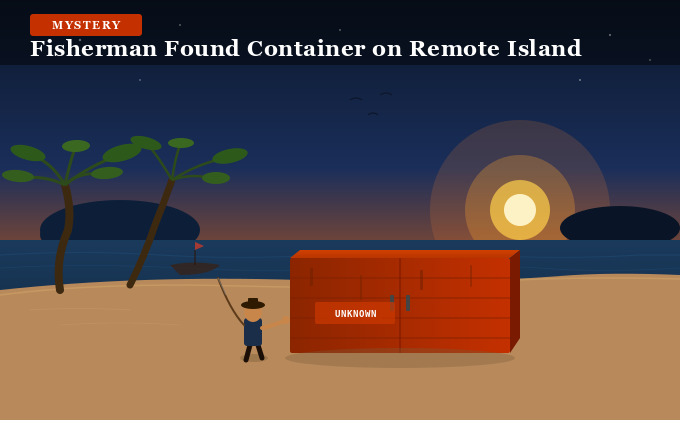
Rising from the pale sand of an uninhabited shoreline, half-buried in the earth as if the island itself had tried to swallow it, was a massive steel shipping container. Rust-red and enormous, it sat at an angle, its doors facing the water, almost as if it had been placed there deliberately — or had washed ashore with terrible force.
“I thought I was dreaming,” Miguel later told local journalists. “You go out to fish for grouper, and you find something like this. I circled the island three times before I had the courage to go closer.”
The Discovery
Miguel anchored his boat in the shallows and waded to shore, his rubber boots sinking into the warm, wet sand. The container was standard in size — roughly 40 feet long and 9 feet tall — the kind used to ship goods across oceans on massive cargo vessels. It bore no visible shipping company markings, though traces of stenciled letters could still be made out beneath layers of rust and barnacles. The serial number, if there ever was one, had been completely eaten away by corrosion and time.
The doors were sealed. A heavy industrial padlock, surprisingly intact compared to the rest of the container’s weathered body, held the latch in place. Miguel, being a careful and experienced man of the sea, did not attempt to open it. Instead, he took photographs with his mobile phone — a dozen shots from every angle — and radioed the coastguard.
What followed would thrust this quiet fisherman into the center of a mystery that authorities, maritime experts, and internet sleuths are still trying to unravel.
Where Did It Come From?
The island where Miguel made his discovery is part of a remote archipelago rarely visited by commercial vessels. It sits far outside the major shipping lanes, which makes the container’s presence all the more puzzling. Maritime investigators who arrived within 48 hours of Miguel’s report were immediately struck by how far from any known route the container had traveled — or been placed.
According to preliminary analysis, the container’s exterior showed signs of prolonged ocean exposure, suggesting it had been at sea or on that island for anywhere between two and six years. The barnacle species clinging to its lower half were consistent with warm equatorial waters, narrowing its origin zone — but not by much. The Pacific Ocean is, after all, the largest body of water on Earth.
Experts from the port authority examined photographs of the locking mechanism and noted that the padlock was not a standard maritime lock. It was the kind of heavy-duty lock used in industrial warehouses or secured storage facilities on land — an unusual choice for a shipping container, which typically uses proprietary twist-rod latches. Someone had modified this container. Someone had locked it very deliberately.
What Was Inside?
This is the question the entire world wants answered. When authorities finally opened the container — a process that took several hours due to the seized lock mechanism and the container’s partially buried state — what they found raised more questions than it answered.
The interior was dry. This alone was remarkable. Given the exterior condition and the estimated years of exposure, a completely dry interior suggested the container had been sealed with exceptional care, possibly with industrial sealant applied to every seam and joint. Inside, wrapped in heavy waterproof sheeting, were dozens of crates of varying sizes. Some were wooden. Some were reinforced metal. All were locked or nailed shut.
Authorities have not disclosed what was found inside those crates. A brief official statement confirmed only that “the contents are under investigation and do not appear to pose an immediate public safety risk.” What that carefully worded phrase actually means — what was ruled out, what remains under analysis — has not been made public.
The silence from officials has, naturally, fueled an enormous amount of speculation online. Theories range from the mundane to the extraordinary: black market goods, lost historical artifacts, a time capsule, the remnants of a failed smuggling operation, scientific equipment, or even personal belongings from a disaster at sea. One viral post suggested the container was linked to a cargo vessel that disappeared from tracking systems in the region several years ago — a claim that has neither been confirmed nor denied.
Miguel Santos: The Man Who Found It
Lost in the swirl of international media attention is the man at the center of it all. Miguel Santos is not a dramatic person. He is a fisherman. He wakes before dawn, he repairs his nets by hand, he knows the sea the way most people know their own living rooms. His small home on the coast is decorated with hand-painted floats and old maps, and his dog, a sunburned mutt named Capitão, follows him everywhere.
When asked how he feels about his sudden fame, Miguel smiled quietly and shrugged. “The sea has secrets,” he said. “I have been on the water for thirty-five years. I have seen things I cannot explain. This is just one more thing I cannot explain.”
He has been interviewed by national television, featured in international newspapers, and offered money by at least two documentary production companies. He has declined all of them. He did, however, accept a modest reward from the port authority for reporting the discovery promptly and responsibly — money he has reportedly used to repair the aging engine on his boat.
“I just want to go back to fishing,” he told a reporter who tracked him down at his favorite café. “But now everybody knows my face.”
The Bigger Picture: Lost Containers at Sea
Miguel’s discovery, as unusual as it seems, is not without precedent. The ocean is, in a very real sense, full of lost things. According to maritime industry estimates, thousands of shipping containers fall overboard from cargo vessels every single year. The World Shipping Council has tracked incidents over multiple years and consistently finds that hundreds to over a thousand containers are lost at sea annually, though the true number may be higher because not all incidents are reported.
These containers drift on currents for years, sometimes decades, before washing ashore. Some sink immediately. Others float just below the surface, invisible and dangerous to smaller vessels. Many eventually end up exactly like Miguel’s discovery: stranded on remote beaches, half-buried, barnacle-covered, and full of whatever was inside when they left port.
The contents recovered from lost containers over the years read like an inventory from a surreal dream. Thousands of Nike sneakers washed ashore along the U.S. Pacific Coast in the 1990s after a container ship accident. Rubber ducks — millions of them — have been tracked across oceans for decades, contributing real data to ocean current research. Luxury cars, alcohol, electronics, industrial machinery, frozen food, and stranger things have all been found at one point or another, bobbing in the tide or beached on remote shorelines.
The ocean does not keep secrets forever. It gives things back, eventually, though often changed beyond recognition.
An Investigation Without Easy Answers
As of the time of this writing, the investigation into Miguel’s container remains open. The crates removed from the interior have been transported to a secure facility on the mainland. Forensic teams, customs officials, and maritime specialists are all reportedly involved. Interpol has been notified, though the nature of their involvement has not been specified.
The island itself has temporarily been closed to the small number of tourists and researchers who occasionally visit. Officials cite the ongoing investigation as the reason, though local conservation groups have noted with some concern that heavy equipment used to remove the container may have disturbed a nesting site for endangered seabirds on the southern edge of the island.
Even the most seasoned maritime investigators have reportedly expressed surprise at the level of deliberate engineering that went into sealing the container. “This was not accidental loss overboard,” one anonymous source with knowledge of the investigation told a regional news outlet. “This was intentional. Someone put a great deal of effort into keeping whatever was inside dry and intact.”
Who? Why? And for how long had it been there, waiting on that deserted shore, before Miguel Santos happened to steer his wooden boat around the wrong — or perhaps exactly the right — bend in the coastline?
The sea, as Miguel himself might say, is not done with its secrets yet.
Follow this story as more details emerge. If you have information related to missing cargo shipments or unusual maritime activity in the region, contact the relevant maritime authorities.